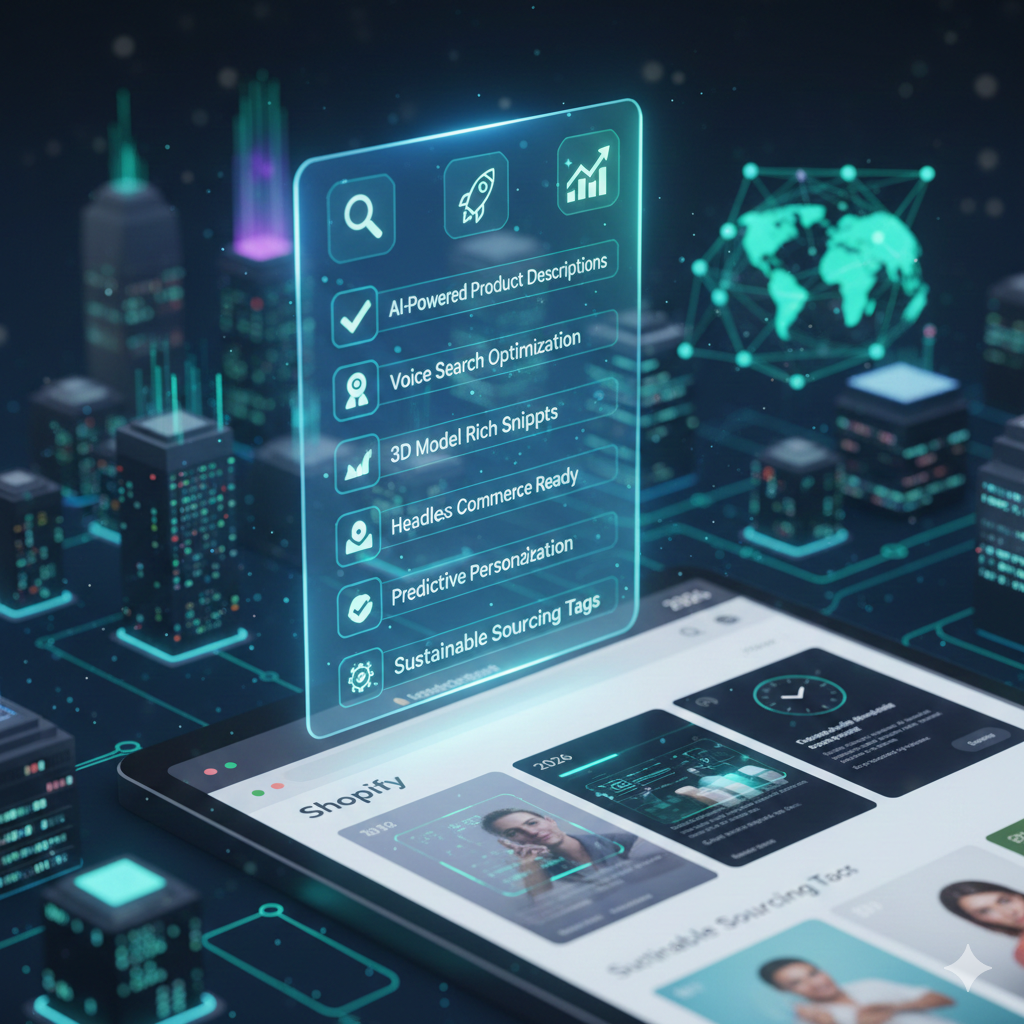
Ranking in 2026 requires a shift from simple keyword density to Technical Authority and AI Readiness. You must ensure your store has a sub-200ms Interaction to Next Paint (INP) score, implement comprehensive JSON-LD Schema for AI agent retrieval, and produce unique content that establishes "Topical Authority" beyond basic product descriptions.
For the over 6.5 million active Shopify stores (Omnisend, 2026), ranking is no longer about keyword density—it’s about Technical Authority and Brand Trust. If your store isn't technically perfect, you aren't just losing human clicks; you are being ignored by the AI agents that now control a quarter of the market.
To thrive in 2026, your Shopify SEO strategy must be split into four critical pillars: Technical Infrastructure, Performance UX, Content Authority, and AI Readiness. According to ZIK Analytics, while 79% of Shopify traffic now comes from mobile, organic search still accounts for 20–30% of total revenue for well-optimized stores.
1. What are the technical requirements for a Shopify store to be 'AI-Ready'?
AI readiness depends on Advanced Schema (JSON-LD) that allows AI agents to instantly parse product variables like price, material, and stock. Without custom-coded schema, your products will be excluded from the automated comparison tables generated by AI assistants, which now control 25% of the search market.
-
Implement Advanced Schema (JSON-LD): Beyond basic product schema, you must implement
Offer,Review, andFAQschema. SEMrush (2025) data shows that stores with custom-built schema see a 37% higher click-through rate than those relying on Shopify’s defaults. -
Fix "Crawl Waste": Use your
robots.txt.liquidfile to block non-essential pages (like/collections/*+*filter loops). Ahrefs notes that 96.5% of web content gets zero traffic, often because search bots are stuck in "crawl loops." -
Verify Google Search Console (GSC) Indexing: Monitor your "Indexing" report weekly. In 2026, even a minor increase in "Crawled - Currently Not Indexed" pages signals to Google that your content lacks "Helpful Content" value.
2. How does Interaction to Next Paint (INP) affect my Shopify store's ranking?
INP measures the responsiveness of your site to user interactions; in 2026, an INP higher than 200ms can penalize your rankings and shrink conversions by 7%. You must minimize "Main Thread" work by auditing app scripts and using next-gen image formats like AVIF to maintain a "snappy" user experience.
-
Optimize for INP (< 200ms): Interaction to Next Paint is now a core ranking factor. If a user clicks "Add to Cart" and the site hangs for half a second, your ranking will suffer. Minimize "Main Thread" work by deferring non-critical JavaScript.
-
Next-Gen Image Formats: Use WebP or AVIF for all assets. Queue-it (2026) statistics show that 25% of pages could save 250kb instantly through proper compression, leading to a 5.6% increase in conversion rates per second saved.
-
Audit "App Bloat": The average Shopify Plus store uses 10–15 apps, but each one adds third-party scripts. According to Queue-it, every third-party script adds an average of 34.1 milliseconds to load time.
3. How can I improve my Shopify store's authority to satisfy Google’s Helpful Content Update?
You build authority by replacing manufacturer descriptions with unique, experience-led content and integrating Video SEO. Using conversational, question-based headers also allows you to capture long-tail queries from voice search and AI chat assistants.
-
Unique Product Descriptions: Avoid manufacturer descriptions. OptiMonk (2026) found that 84.7% of top-performing Shopify stores maintain an active blog to build topical authority.
-
Video SEO Integration: Product videos are no longer optional. OptiMonk data reveals that video ads and on-page videos generate up to 3x more clicks than static images. Ensure your videos have
VideoObjectschema. -
Conversational Headers: Optimize for voice search. Instead of just "Blue Yoga Mat," use headers like "What is the best non-slip yoga mat for hot yoga?" to capture long-tail, conversational queries.
4. Why is mobile-first design the most critical factor for Shopify SEO in 2026?
With 69% of all purchases happening on mobile devices, both Google and AI agents prioritize mobile-first precision. Features like "thumb-friendly" navigation and accelerated checkouts (like Shop Pay) are now essential for maintaining both search visibility and a 1.7x higher conversion rate.
2026 Shopify SEO Performance Matrix
| Metric | 2026 Target | Impact on Conversions | Why It Matters |
| INP (Responsiveness) | < 200ms | +10-15% | Essential for "snappy" feel |
| LCP Loading | < 2.5s | +7% per second | Google's primary speed metric |
| Mobile Traffic Share | > 75% | Critical | Primary source of buyers |
| Schema Coverage | 100% | +37% CTR | Key for AI-agent retrieval |
| Blogging Frequency | 1-2x Weekly | High | Builds "Entity" authority |
Conclusion
Ranking a Shopify store in 2026 is a game of technical precision. By focusing on INP responsiveness, AI-readable schema, and high-authority content, you ensure that your store isn't just a destination, but a highly-cited "entity" in the eyes of Google and modern AI agents.
The "One-Second" rule is more real than ever: a site that loads in 1 second has a conversion rate 5x higher than one that loads in 10 seconds. Don't let a slow technical foundation be the reason you lose money.