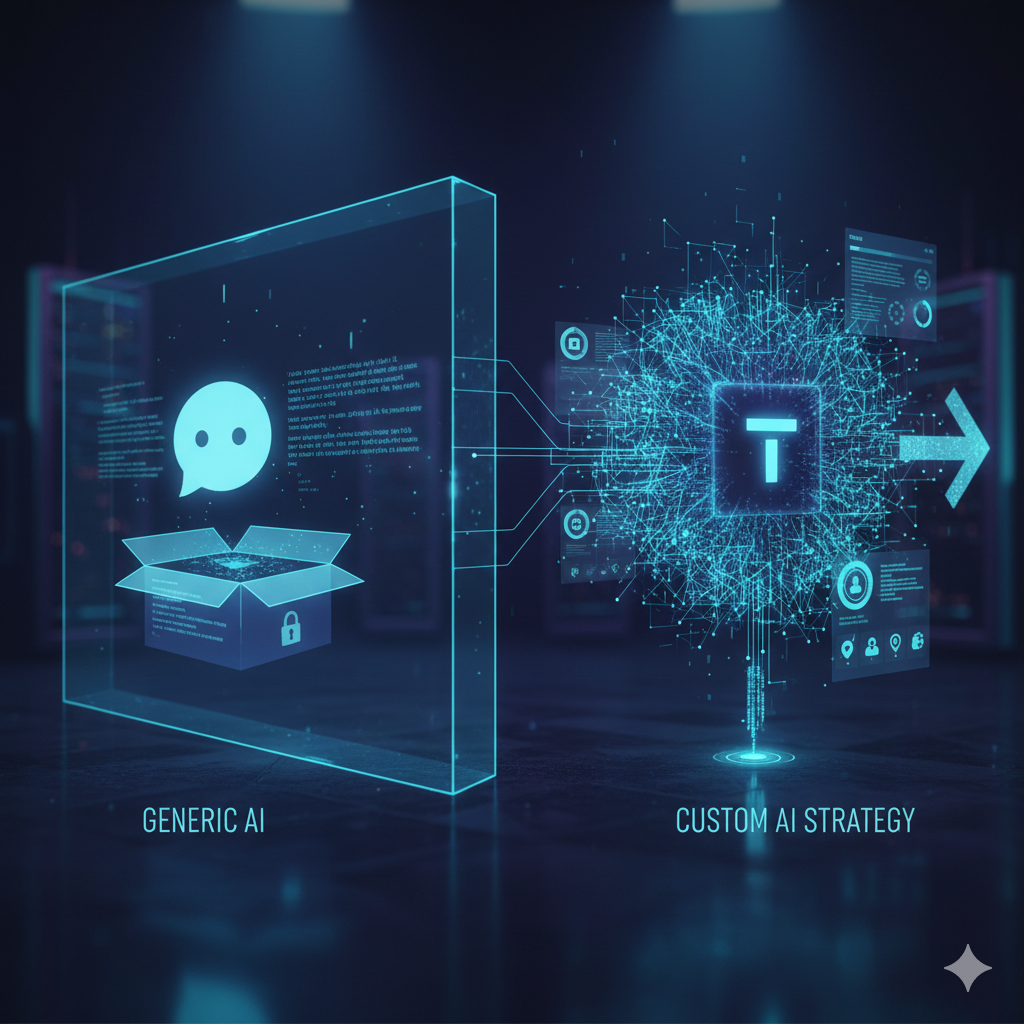
While ChatGPT Plus is an excellent personal productivity tool, a custom AI strategy is required for businesses to integrate proprietary data securely, eliminate AI hallucinations through RAG, and deploy autonomous agents that actually perform work within your specific software ecosystem.
As Gartner recently reported, the era of AI pilots has ended; nearly 80% of enterprises have now moved past experimentation into full-scale production. However, a significant rift has emerged between companies that use AI as a generic utility and those that use it as a custom-engineered competitive engine.
A ChatGPT Plus account in 2026 is the equivalent of having a telephone in 1990—it is the baseline for participation, not a strategy for dominance. To truly scale, businesses are shifting toward Domain-Specific Language Models (DSLMs) and Multi-Agent Systems (MAS) that live within their own secure infrastructure.
The competitive gap in 2026 is no longer defined by who uses AI, but how deeply that AI is integrated into unique business logic. According to Forrester’s 2026 Technology Predictions, businesses relying solely on off-the-shelf, generic AI tools are seeing a "diminishing return on innovation," while those investing in custom AI architectures are reporting 3x to 5x higher ROI on their automation spend.
1. What are the main limitations of using generic AI tools like ChatGPT for business?
ChatGPT Plus is a powerful, general-purpose tool, but for a business in 2026, it suffers from three fatal flaws: Context Blindness, Data Leakage Risks, and the Hallucination Tax.
-
Context Blindness: Generic models are trained on the public internet. They don't know your specific inventory levels, your proprietary 10-year client history, or the subtle nuances of your industry’s regulatory environment. IDC reports that vertical-specific AI models reduce error rates by 20–40% compared to generic LLMs.
-
The Hallucination Tax: In a high-stakes business environment, a 5% hallucination rate is an expensive liability. Custom strategies utilize Adaptive-RAG (Retrieval-Augmented Generation), which forces the AI to cite your own "Internal Source of Truth" before answering.
-
Commoditization: If you and your competitor are both using the same ChatGPT prompt, your output is identical. You cannot build a "moat" around your business using a tool that is equally available to everyone for $20 a month.
2. The Move to Agentic Workflows (The 2026 Standard)
In 2026, we have moved beyond "Chat" and into "Agents." An agent doesn't just talk about work; it performs it. Deloitte’s 2026 Tech Trends highlights that only 11% of organizations have successfully moved agents into production, yet those who have are seeing a 10% increase in total company productivity.
A custom AI strategy allows you to build a "Silicon Workforce" of specialized agents:
-
The Researcher Agent: Scans global markets and internal sales data.
-
The Analyst Agent: Identifies discrepancies in supply chain logistics.
-
The Executive Agent: Automatically drafts purchase orders based on the Analyst’s findings.
These agents interact via the Model Context Protocol (MCP), a 2026 industry standard that allows custom AI to "talk" to your existing CRM, ERP, and Shopify/Wix backends securely.
3. Sovereign AI: Security and Regulatory Compliance
With the European AI Act and similar global regulations now in full effect in 2026, "Sovereign AI" has become a board-level priority. Sending sensitive customer data to a public cloud-based model like ChatGPT Plus can lead to massive compliance fines.
PwC’s 2026 Responsible AI Survey found that 50% of enterprises now prefer "on-premise" or "private-cloud" AI deployments to ensure data residency. A custom strategy allows you to:
-
Keep your data within your own virtual private cloud (VPC).
-
Fine-tune models on your own IP without that data being used to train the next public version of a model.
-
Implement "Critic Agents" that autonomously audit AI outputs for bias or compliance before they reach a customer.
Comparison: Generic AI vs. Custom Business AI Strategy
| Feature | ChatGPT Plus (Generic) | Custom AI Strategy (Agentic) |
| Data Source | Public Internet (Static) | Your Proprietary Data (Real-time) |
| Accuracy | General (Prone to hallucinations) | High (Grounded in Adaptive-RAG) |
| Security | Shared Cloud (Public) | Sovereign/Private Cloud |
| Functionality | Text/Image Generation | Autonomous Task Execution (Agents) |
| Integration | Limited/Manual | Deep API & ERP Orchestration |
| ROI (2026 Avg.) | ~1.2x (Productivity) | ~4.5x (Operational Efficiency) |
4. The Math of Custom AI ROI
The financial argument for a custom strategy is rooted in the elimination of manual "human-in-the-loop" bottlenecks. In 2026, the ROI of a custom AI implementation can be calculated by the formula:

Where:
-
G_{productivity} is the gain from automating multi-step workflows.
-
R_{loss\_prevention} is the cost saved by reducing human error in data processing.
-
C_{custom\_dev} is the cost of building the custom AI infrastructure.
According to McKinsey, companies that "rewire" their processes for custom AI see an average Earnings Before Interest and Taxes (EBIT) increase of 15% to 25% within the first 18 months.
5. How to Start: The 2026 AI Roadmap
Moving from a ChatGPT account to a Custom Strategy requires a technical partner who understands the bridge between Model Training and Web Integration.
-
Data Cleanliness Audit: AI is only as good as the data it consumes. 2026 is the year of "Data Wrangling."
-
Identify High-Value Workflows: Don't automate everything. Focus on the 20% of tasks that drive 80% of your revenue.
-
Implement an Orchestration Layer: Use frameworks like LangChain or AutoGPT integrated into your Python/Django or Laravel backend to manage your agentic swarm.
-
Deploy a "Human-on-the-loop" Governance System: Ensure humans provide the final "green light" for high-impact decisions.
Conclusion
A ChatGPT Plus account is a tool for the individual; a Custom AI Strategy is an infrastructure for the enterprise. In 2026, as AI agents begin to handle up to 40% of all business interactions, the companies that succeed will be those that own their models, secure their data, and engineer their own unique brand of digital intelligence.