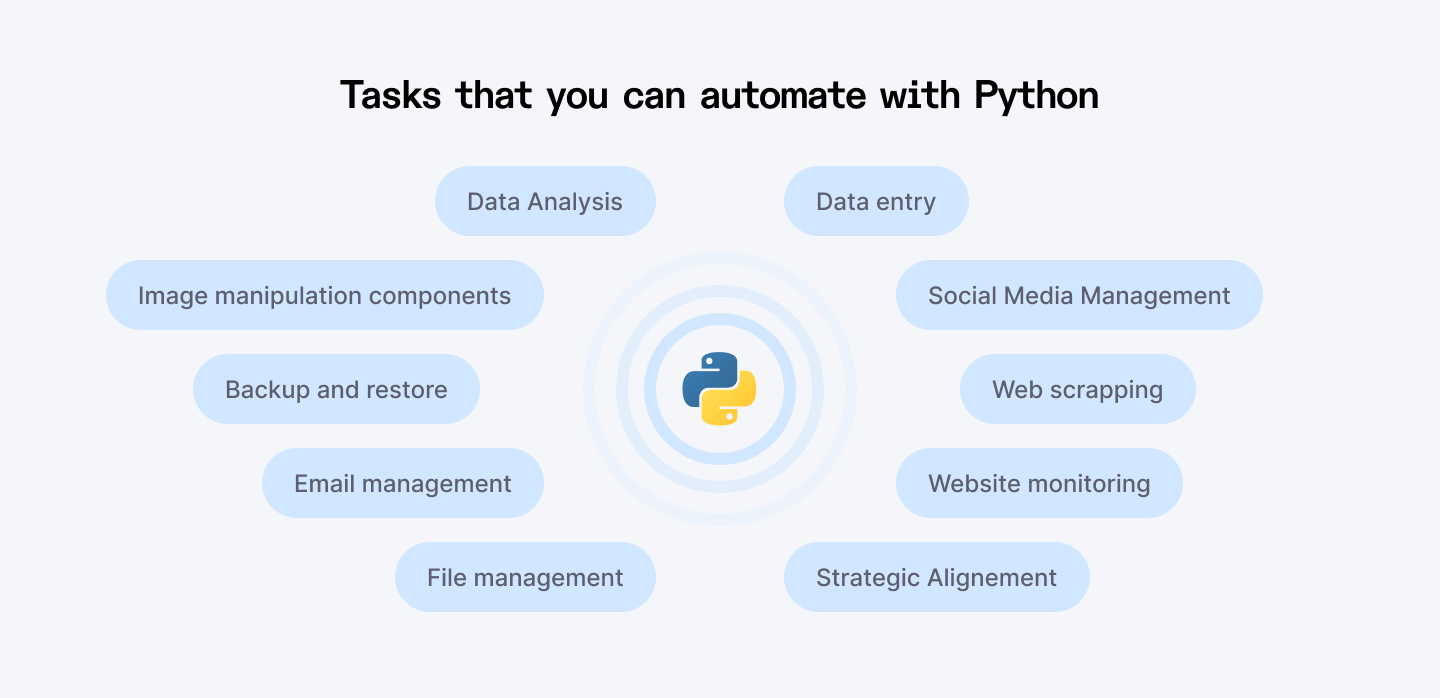
You can automate data entry by deploying custom Python scripts that act as a secure "bridge" between APIs, using libraries like FastAPI and Polars to sync, validate, and move data in real-time without manual intervention.
In 2026, the greatest tax on your business growth isn't regulation or competition—it’s the "Data Silo Tax." Despite the abundance of SaaS tools, most businesses still operate as a collection of digital islands. Employees spend an average of 3.6 hours per week copy-pasting data between tabs, according to Rossum’s 2026 Automation Report.
While low-code tools like Zapier or Make are excellent for simple "If This, Then That" triggers, they often struggle with high-volume data, complex logic, or the proprietary security requirements of 2026. This is where Custom Python Scripts become the "digital glue" of the modern enterprise.
According to Gartner, by the end of 2026, 30% of enterprises will have automated more than half of their network and data activities—a 200% increase from 2023. The shift we are seeing this year is moving away from "Basic RPA" (Robotic Process Automation) toward Intelligent Orchestration.
1. What are the hidden risks of manual data entry for businesses in 2026?
Beyond being slow, manual data entry in 2026 poses significant security and compliance risks, where a single typo can lead to regulatory audits under new data provenance laws like the European AI Act.
-
The Accuracy Mandate: 61.6% of operations leaders now prioritize accuracy over speed. In 2026, the cost of rectifying a manual error is estimated to be 10x higher than the cost of the initial entry.
-
The "Fragmented ROI" Killer: Forrester research indicates that fragmented data "kills" the ROI of expensive SaaS implementations. If your CRM doesn't talk to your ERP, you aren't running a business; you're running a museum of disconnected data.
2.Why is Python the best language for bridging data between different SaaS platforms?
Python is the industry standard for automation because its ecosystem—specifically tools like Polars for speed and MCP for AI agent connectivity—allows it to communicate with almost any modern or legacy software interface.
-
Polars & Pandas: For ultra-fast data manipulation. In 2026, Polars has become the go-to for processing millions of rows in milliseconds, significantly outperforming legacy Excel-based workflows.
-
FastAPI: Used to create "Micro-Services" that allow your custom scripts to act as a private API for legacy software that doesn't natively support modern integrations.
-
Model Context Protocol (MCP): A new 2026 industry standard that allows Python scripts to serve as "connectors" for AI agents, enabling them to safely read and write to your private databases.
Comprehensive Case Study: The "Intelligent Order Reconciliation" Bridge
To see the power of custom scripting, let's look at a hypothetical 2026 scenario for "Lumina Home Decor," a mid-sized retailer.
The Challenge:
Lumina sells on Shopify and Amazon. They need to sync every sale into a legacy NetSuite ERP for accounting. However, there are three "friction points" that standard automation tools can't handle:
-
Custom SKU Mapping: Shopify SKUs (
LH-Blue-Velvet) don't match NetSuite IDs (NS-9921-B). -
Fraud Detection: They need to cross-reference the customer's IP address with a global blacklist before the order hits the warehouse.
-
Dynamic Currency: They sell in 15 countries and need the exact exchange rate at the second of the transaction for tax compliance.
The Solution: A Custom Python "Bridge" Script
Instead of a human clerk spending 15 hours a week manually entering these orders, a custom Python script runs every 10 minutes.
import hmac
import hashlib
import requests
import asyncio
from datetime import datetime

# 2026 Best Practice: Using async for non-blocking API calls
async def process_new_orders():
    # 1. Fetch orders from Shopify API
    orders = requests.get("https://lumina-decor.myshopify.com/admin/api/2026-01/orders.json").json()

    for order in orders['orders']:
        # 2. Intelligent SKU Mapping (Local Dictionary or DB)
        sku_map = {"LH-Blue-Velvet": "NS-9921-B", "LH-Gold-Mirror": "NS-4432-G"}
        internal_id = sku_map.get(order['line_items'][0]['sku'], "UNKNOWN")

        # 3. AI-Powered Fraud Check (Hypothetical Service)
        fraud_score = check_fraud_agent(order['customer']['ip_address'], order['total_price'])

        if fraud_score < 20: # If score is safe, proceed
            # 4. Get Real-Time FX Rate for 2026 Compliance
            fx_rate = requests.get(f"https://api.fx-rates.com/v1/convert?from={order['currency']}&to=USD").json()
            reconciled_price = float(order['total_price']) * fx_rate['rate']

            # 5. Push Clean Data to Legacy ERP (NetSuite)
            payload = {
                "erp_id": internal_id,
                "usd_value": reconciled_price,
                "status": "Verified",
                "timestamp": datetime.now().isoformat()
            }
            requests.post("https://netsuite-internal-api.lumina.com/v1/sync", json=payload)
            print(f"Order {order['id']} synced successfully.")
        else:
            # Flag for human review in Slack
            send_slack_alert(f"Warning: Potential Fraud detected on Order {order['id']}!")

def check_fraud_agent(ip, amount):
    # Logic for 2026 AI security check
    return 15 # Example score

# Run the automation
if __name__ == "__main__":
    asyncio.run(process_new_orders())
3. Should I use no-code tools or custom Python scripts for my business automation?
While no-code tools are great for simple tasks, custom Python scripts are superior for enterprise needs because they offer unlimited logic complexity, better data privacy (sovereign data), and zero "per-task" scaling costs.
| Feature | No-Code (Zapier/Make) | Custom Python Scripts |
| Data Privacy | Passes through 3rd party servers | Stays in your VPC (Sovereign Data) |
| Logic Complexity | Linear (Hard to do "If/Then" loops) | Unlimited (Turing Complete) |
| Volume Scaling | Costs increase per task | Flat (Server costs are fixed/low) |
| Security | Shared API Keys | Hardware-backed Encryption |
| AI Integration | Basic prompts | Agentic RAG & MCP Support |
4. How does agentic automation help solve the problem of data silos?
Agentic automation uses AI-driven Python scripts that can "reason" and interact with legacy software through tools like Playwright, allowing them to perform complex tasks in systems that lack a traditional API.
McKinsey’s 2026 Tech Outlook notes that "High Performers" are redesigning workflows so that agents can take "Task Ownership." A custom Python script can act as the "hands" for an AI agent, allowing it to navigate a legacy web interface (using tools like Playwright) to enter data where no API exists. This bridges the gap for 20-year-old software that previously required manual entry.
Conclusion: Stop Fighting Your Data
In 2026, your team’s value lies in their ability to make strategic decisions, not their ability to move data from Point A to Point B. Custom Python scripts provide a scalable, secure, and incredibly cost-effective way to ensure your apps work as a single, cohesive organism.
By bridging the gap between your Shopify store, your custom-built Wix portal, and your internal accounting software, you don't just save time—you create a "Source of Truth" that powers your entire business intelligence.